Minimum Energy Efficiency Standards (MEES) place legal requirements on commercial landlords in England and Wales. Under current regulations, most privately rented non-domestic properties must achieve a minimum EPC rating of E (or have a valid registered exemption) to grant a new lease, renew or extend an existing lease, or continue letting a property.
Clifton Energy helps landlords, managing agents and property teams manage MEES compliance by combining accredited commercial EPC assessments with practical improvement planning. Our service helps you confirm whether a property falls within MEES scope, assess its current compliance position, identify cost-effective improvements to improve EPC ratings, and register exemptions where compliance is not achievable.
The aim is to reduce letting risk, maintain regulatory compliance and provide a clear audit trail should enforcement authorities request evidence.
What is a MEES service?
A MEES service is not a separate certificate issued by the government. Instead, MEES compliance is assessed using a building’s EPC rating, alongside the requirements set out in the Minimum Energy Efficiency Standards Regulations. Compliance may involve improving the building’s EPC rating or registering a valid exemption on the PRS Exemptions Register.
A typical MEES compliance service includes reviewing whether a property falls within scope of the regulations, assessing the current EPC status, commissioning a new commercial EPC assessment where required, and providing practical improvement advice designed to raise the building’s EPC rating and achieve compliance.
Why MEES Compliance Matters for Commercial Landlords
MEES compliance is critical for commercial landlords and managing agents. A property is considered “sub-standard” if it has an EPC rating below E and is let under a qualifying tenancy. If a building falls below this threshold and no valid exemption is registered, landlords may face letting restrictions, enforcement action and financial penalties linked to the property’s rateable value.
What Are MEES and How Are They Measured for Commercial Buildings?
Minimum Energy Efficiency Standards (MEES) set minimum energy performance requirements for privately rented commercial property in England and Wales under the Energy Efficiency (Private Rented Property) Regulations 2015.
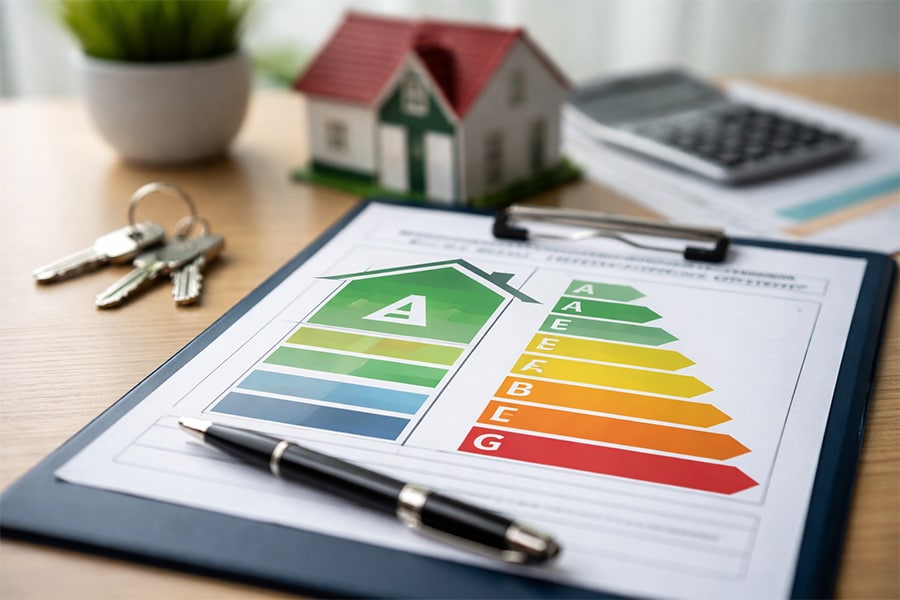
For non-domestic buildings, MEES compliance is measured using the Energy Performance Certificate (EPC) rating, which runs from A (most efficient) to G (least efficient). Under the current rules:
- The minimum required rating is EPC band E
- A property is considered “sub-standard” if the EPC rating is F or G
- An EPC is generally valid for MEES purposes for up to 10 years, provided no newer EPC has been registered.
Commercial EPCs are asset ratings, meaning they are based on the building’s fabric and fixed services such as heating, lighting and HVAC systems, rather than the actual energy use of occupants. Because of this, some operational energy savings may not improve the EPC rating unless they affect the building elements used in the EPC calculation.
When MEES Is Required for Commercial Property
For commercial landlords in England and Wales, Minimum Energy Efficiency Standards (MEES) place restrictions on letting properties with low EPC ratings.
Key milestones include:
- From 1 April 2018: Landlords cannot grant a new lease or renew an existing lease for a sub-standard commercial property (EPC rating F or G) unless a valid exemption is registered.
- From 1 April 2023: Landlords cannot continue letting a sub-standard commercial property on an existing tenancy without a valid exemption.
MEES typically applies where:
- The property is non-domestic (commercial)
- The building is legally required to have an EPC
- The tenancy is for a term between 6 months and 99 years
If a property is vacant and not being let, landlords generally do not need to take action until they plan to rent it again.
Some buildings may fall outside EPC and MEES scope in specific circumstances, such as certain listed buildings, temporary structures, places of worship, low-energy industrial buildings, and small detached buildings under 50m².
Because eligibility can depend on several factors, a MEES compliance review should confirm EPC obligations, tenancy details and the property’s current energy rating.
What Happens During a MEES Assessment and EPC Survey?
A MEES assessment reviews whether a commercial property meets the Minimum Energy Efficiency Standards and identifies the most practical route to compliance. The process typically answers four key questions:
Is the property in scope of MEES?
This considers EPC requirements, tenancy type and jurisdiction.
What is the current compliance position?
The property’s EPC rating and certificate validity are reviewed to determine whether it meets the minimum EPC E standard.
What improvements could achieve compliance?
Targeted measures are identified to improve the EPC asset rating and help the building reach the required standard.
Is an exemption required?
If compliance cannot reasonably be achieved, the correct PRS Exemptions Register route and supporting evidence are identified.
FAQs
No. There is no separate “MEES certificate.” Compliance with Minimum Energy Efficiency Standards (MEES) is determined by the property’s EPC rating and whether the building meets the minimum requirement of EPC E or higher, or has a valid exemption registered on the PRS Exemptions Register.
No. Commercial MEES regulations generally apply where a property is legally required to have an Energy Performance Certificate (EPC) and the tenancy is between 6 months and 99 years. The rules typically affect privately rented commercial buildings with an EPC rating of F or G, although some buildings may fall outside EPC scope.
An EPC is normally valid for 10 years. If the certificate has expired, it may no longer be valid for MEES compliance or for marketing a property for sale or letting. Landlords often need to commission a new commercial EPC assessment to confirm the building’s current rating.
Failure to comply with commercial MEES regulations can result in financial penalties linked to the property’s rateable value. Fines can reach up to £150,000 for longer breaches, and enforcement authorities may also publish details of the breach, creating reputational risk.
The government has previously consulted on tightening commercial MEES requirements, potentially raising the minimum standard to EPC C or EPC B in future years. However, until new legislation is introduced, the current legal requirement remains EPC rating E or higher for most privately rented commercial properties.
Why choose Clifton Energy
Clifton Energy specialises in commercial energy compliance, supporting property owners and managing agents with MEES compliance, commercial EPC assessments, Display Energy Certificates (DECs), TM44 air-conditioning inspections and Part L energy calculations under the Energy Performance of Buildings Regulations.
All assessments are carried out by accredited energy professionals, led by James Rankin, an accredited Non-Domestic Energy Assessor (Level 4) with additional qualifications for TM44 inspections and DEC assessments. This ensures a technically robust and fully compliant service.
By combining EPC expertise with MEES compliance advice, Clifton Energy helps landlords understand their compliance position, identify effective improvement measures and maintain the evidence required for regulatory audits or exemption registrations.
This integrated approach allows EPC modelling, improvement planning and MEES compliance strategy to be managed together, reducing risk and helping commercial property portfolios remain legally lettable.
For MEES, contact Clifton Energy today.